React Hooks: useRef

Furkan is a software engineer and frontend developer, whose main purpose is to create best optimal experience for user but also keeping the application or project as performant as possible.
He is deeply interested on web technologies and he is building new projects in this subject. He is especially familiar with React, Vue, Node and Java. You can check out what he built on his GitHub account. There is potential ways to connect with him at the end of this summary 👇
Things he like to do; ✔ Trying to solve other people's struggles ✔ Teaching or telling some subject he know to friends or colleagues ✔ Building different kinds of projects ✔ Meeting & talking with new people ✔ Listening podcasts ✔ Playing Chess ✔ Watching drama | sci-fi movies ✔ Listening music while I travelling or trying to fix problems ✔ Researching next generation technologies like cyptocurrency, IoT, smart devices
If you want to reach out with him, here is how you can do it;
🔼 Blog: https://blog.furkanozbek.com/ 🔼 GitHub: https://github.com/afozbek 🔼 Mail: abdullah.furkan.ozbek@gmail.com 🔼 Twitter: https://twitter.com/afozbek_ 🔼 Instagram: https://instagram.com/furkan.codes/
Thanks for reading ✨
1. Definition
useRef is a built-in React hook that accepts one argument as the initial value and returns a reference (aka ref).
A reference is an object having a special property current
There are two main uses of useRef;
- Accessing the DOM nodes or React elements
- Keeping a mutable variable.
const refContainer = useRef(initialValue);
2. Accessing the DOM Elements
This is performed in 3 steps:
- Define the reference to access the element
- Assign the reference to
refattribute of the element - After mounting,
elementRef.currentpoints to the DOM element.
This is equivalent of
import React, { useRef } from "react";

const CustomTextInput = () => {
  const textInput = useRef();

  focusTextInput = () => textInput.current.focus();

  return (
    <>
      <input type="text" ref={textInput} />
      <button onClick={focusTextInput}>Focus the text input</button>
    </>
  );
}
3. Keeping a Mutable Variable
We have two ways of keeping data between re-renders:
- In the component state: Every time the state changes, the component will be re-rendered.
- In an instance variable: The variable will persist for the full lifetime of the component. Changes in an instance variable won’t generate a re-render.
In functional components this would be;
- In a state variable:
useStateoruseReducer. Updates in state variables will cause a re-render of the component. - In a ref: Equivalent to instance variables in class components. Mutating the
.currentproperty won’t cause a re-render.
4. Updating Ref
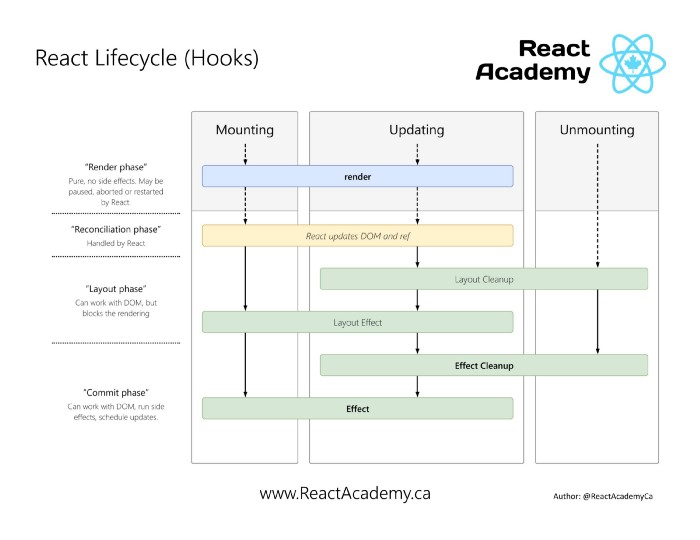
Updating a ref variable is a side effect therefore needs to be done inside useEffect or useLayoutEffect
In React all side effect should be inside Layout Phase.
import React, { useRef } from "react";

const RenderCounter = () => {
  const counter = useRef(0);

  useEffect(() => {
    // Every time the component has been re-rendered,
    // the counter is incremented
    counter.current = counter.current + 1;
  });

  return (
    <h1>{`The component has been re-rendered ${counter} times`}</h1>
  );
};
5. Summary
The useRef Hook lets us create mutable variables inside functional components.
There are three main key points that you should keep in mind when using the useRef Hook;
- A ref created with useRef will be created only when the component has been mounted and preserved for the full lifecycle.
- Refs can be used for accessing DOM nodes or React elements, and for storing mutable variables (like with instance variables in class components).
- Updating a ref is a side effect so it should be done only inside a useEffect (or useLayoutEffect) or inside an event handler.


